Women and non-binary is not a thing.
Please stop trying to make it one.

I’ve only once had a post go properly ‘viral’ and of course, to my great chargrin, it was the one time I foraged into policing other people’s language.
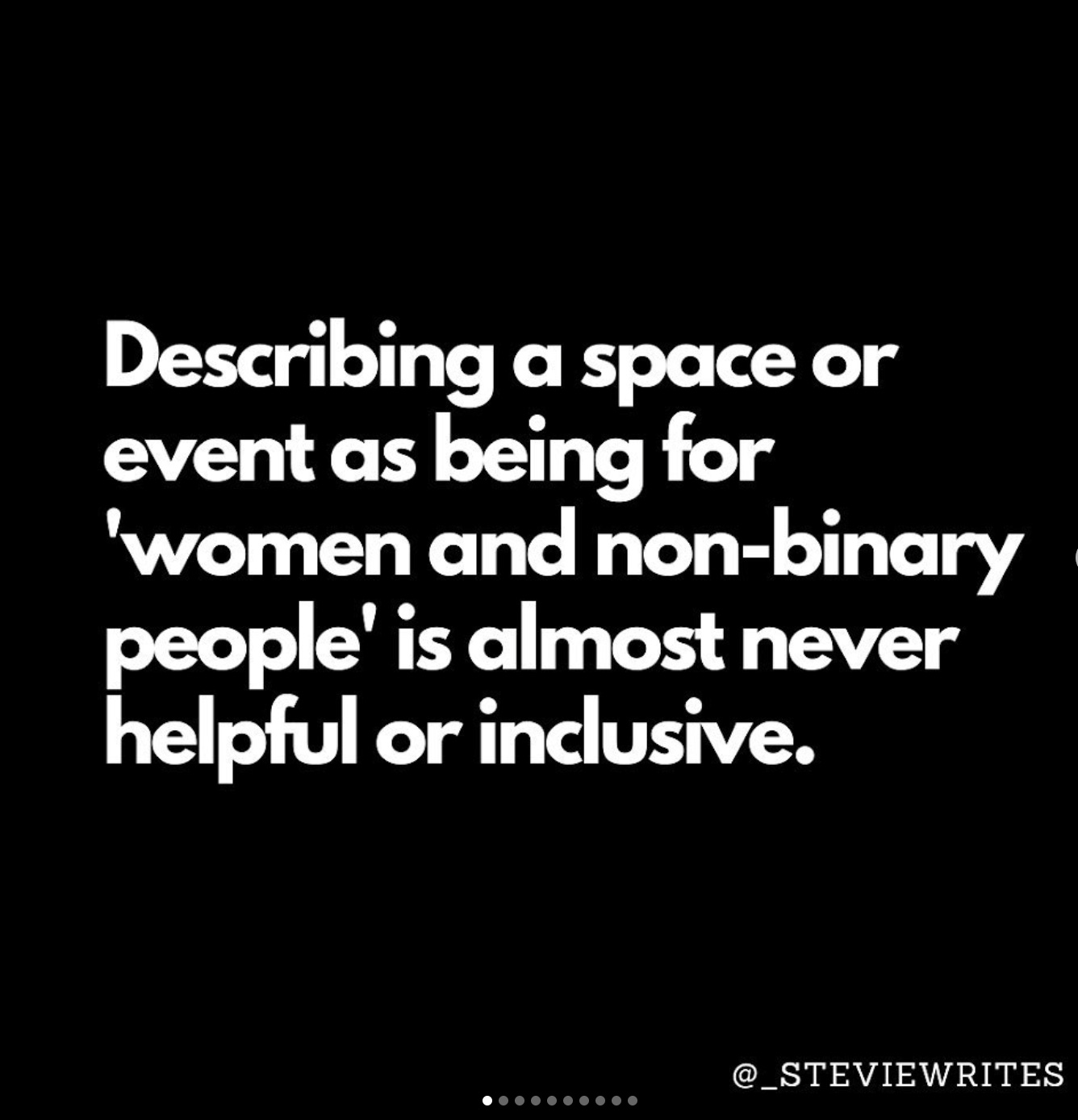
It seems however, despite this sentiment being relatively widespread attempts to group women and non-binary people together won’t die.
Women and femmes, women and non-binary and the tortured “FLINTA*” which is a German acronym for "women, lesbians, intersex, non-binary, trans and agenda” with an asterisk helpfully denoting everyone else we forgot, seem to be popping up everywhere.
So I am once again asking, for the love of everything holy, please stop trying to create this unholy union.
There’s actually no need to.
Because, believe it or not, in 2024, it’s actually okay to have a women’s space.
Having a women’s space can be trans inclusive. How? Well it’s simple. Include trans women. Treat them like the other women in your space. Fully include them and act like them being there is as normal as it actually is.
Including AFAB non-binary people, which let’s be real, is generally what “women and non-binary” is all about, is a significantly less inclusive move than having a women’s space that embraces trans women with open arms.
It’s okay for non-binary people to be part of a women’s space. Gender is more complex than internal identity. Gendered spaces are more complex than internal identity. It’s okay to want to share solidarity with women because you see yourself as having once been a woman or because people treat you like a woman, or because you have some other connection to being a woman. This is a normal part of trans identity. Lot of us are complex and multifaceted and it’s okay to seek out a variety of different spaces where different dimensions of this inner diversity can be expressed.
Saying your space is inclusive of women and non-binary people is generally going to be untrue. Non-binary people don’t have a look. They don’t all have experiences of misogyny. Some of them might be people that you, or the people in your venue, think are men. If you’re not inclusive of all gender presentations, you’re not inclusive of non-binary people.
Spaces for women and non-binary people are not ‘safe.’ They might be safer for some people. They are often not safe at all for trans women, transfeminine non-binary people, disabled people, racialised people and a bunch of others. The idea that a Brendan a straight, cisgender man, who is intersex (yes, that’s how it works sometimes) and has an intellectual disability is going to be welcome in the FLINTA* space is laughable. Women - and femininity - also plays a role in dynamics of oppression, especially the kind that would impact Brendan.
Nonetheless, women’s spaces (including ones that include trans women) have a long history in Queer communities and they are mostly about vibes. It’s okay to want and to want to participate in curating spaces like this.
If you’re curating a vibes-based space around gender, the trans inclusive move is to include trans people who are that gender and support non-binary people who align in some way with that gender to attend as well.
Trans women are women. Trans men are men. And non-binary people are non-binary people.
None of these things are women-lite.
I’m avoidant of those spaces, or when I’m feeling spicy I’ll ask if they’re including all nonbinary people or just people they will perceive as women. I also don’t go, because I’d expect to be misgendered the entire time and feel out of place. I’m not woman-lite, I’m nonbinary.
I've found 'people with experience of womanhood' a useful one for getting close to wrapping words around this. It is expansive enough to stretch around how we are socialised throughout life and how we choose to identify as adults - whilst holding onto the fundamental reality that trans & queer folk still exist within a dichotomised world of men and women, which has a powerful impact on how we show up in the world.